On a sunny Saturday afternoon, a group of us gathered inside
Oxo Tower's riverside warehouse, the
Bargehouse, to discuss and debate issues in
Design for development: Seeing beyond the world of wealth.

The discussion was hosted by the
MA Design for Development class at
Kingston University along with Anne Chick who leads this very first year of the course. Anne summaried the course as a, "pathway for design activists" exploring, "who they are, what they do, what their subject is..." The first ever DfD class just graduated, so coinciding with the discussion was a small exhibition of the seven graduating students this year.

The discussion was driven by the question: "
How can the benefits of design be extended beyond the world's wealthy?" and after a small analysis of the question itself, discussions began among the 3-person panel which included
John Thackara (author, founder of international network and conference Doors of Perception and former Programme Director of Dott 07),
Ann Thorpe (author and PhD researcher) and Guy Robinson (Director of Sprout Design). The event was chaired by,
Alistair Fuad-Luke (author and design facilitator).
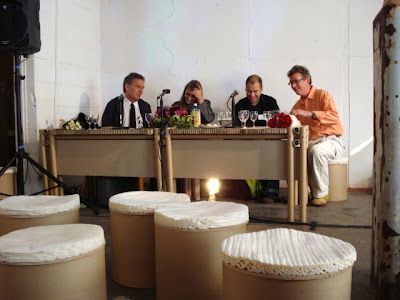
The event was quite long (3.00-5.30pm) so I shall do a short summary of what each speaker said and also bullet points some of the following discussion. I had a few notes and questions of my own which I'll share with you at the end of the post.
Speaker summaryJohn raised four practical points in response to the question. He said that:
- We need to start (in the location of) where we are and think about how to translate questions into design questions;
- Designing for development is by and with people;
- We need to empower people to do what we do (for sustainability in the project itself); and
- We need to think about whole systems and the designer's role as facilitator in bringing people together to be the host or placeholder of conversations among groups of people.
Ann discussed some great issues, which I felt weren't adequately explored in the following discussion. She questioned the current professional
design business model of client services. She says this model makes it challenging to set up a design studio to do work for the developing world. She asked a further question: who else is the client in the developing world? There are
many stakeholders here. Ann identified a few existing professional design business models:
Of the institutional and pro bono models, we might group the work we do done under the umbrella of a
social enterprise. After outlining this topology, Ann asked: So what economic models exist for designers in this area? Doing design work for development is well and good, but designers need to make a living too.
She also went on to ask: Is what designers do in the space of development, a
political act? Ann thinks so. This led her to discuss design in the political sphere and the lack of experience designers have with engaging with politics directly. And designers can engage with politics on both on a national level (eg. the recent US
national design policy initiative) and local level (and I am quite sure all the spaces inbetween).
Guy spoke about the
role of the designer, reflecting that in his practice his role has ranged from that of a professional consultant, to facilitators, to researchers, to innovators and entrepreneurs (which provides nice support for my own research). Guy extended a bit on Ann's point on
design business models saying that they needed to be more innovative if we are to spread and empower design ingenuity in others.
In the Q&A, a few questions/comments I noted down were:- In the context of development, designers are seen as craft makers, and not enough on the more political or strategic end
- What are the skills and knowledge of designers in this context?
- What is special about designers?
- What is our IP?
My notes and reflections (or maybe I should call them my key questions)In research, it's great to have loads of time to read and think about addressing questions which are raised in practice. I know as a designer, I just had to find a way to stop and reflect, because being in delivery-mode all the time just kept on raising new questions adding to the already long list I already had. The discussion on Saturday however raised more questions for me (but that's ok because they are actually questions I have been mulling over too):
- Is it a role for the designer to also be engaged with politics? I tend to think we do it already by default, communicating our message via design propositions and solutions because we are unhappy with the status quo. But if we did think of design as a political act, would that change the way we looked at and approached our work?
- Are there economic models out there to support designing for development? Or do we have to really work with the current context and think of creative new ways to make a living as well as work in areas we feel passionate about? I always think we just need to talk to an economist about this. Or maybe it's an entrepreneur, or venture capitalist, or someone doing research/working in economics and/or business.
- How do we make design relevant to the various contexts we are wanting to work within? For example, how do we go about making design relevant to development agencies if they currently understand designers as crafts people? The same kind of question parallels for design and business space as well, because most business people (like my friends in banking, finance, law, accounting etc) still mostly understand designers as only stylists, decorators etc.
- What is our role (skills, knowledge, IP, position in politics etc.) in these new contexts? I can kind of help answer that one in my PhD research, but Dott 07 was about development in the developed world. Nothing wrong with that, but I am interested in our role in other contexts too, such as those countries we might call transition economies or the developing world/global south.
So, those are some of my notes from the Design for Development panel discussion last Saturday. I really enjoyed the energy, the issues, the questions... I do have more extensive responses to the questions raised by the panel, audience and my own as listed, but a blog post is not quite the appropriate space to discuss this. So I tried to respond to some of these questions in a paper I just submitted last night for a conference happening next month. I'll let you how I progress with it. But the paper was more beginning the conversation (thanks to the word limit). When it's been reviewed/published etc. maybe I'll blog some of the uncut, unedited version here.
 Image from the AMJ website


